Episode #2 Understanding inflation and how it impacts your finances
Episode #2 - Understanding inflation and how it impacts your finances
In Episode #2 of the Jeune Investisseur Podcast, we discussed inflation. Inflation is real and it’s a factor to consider when making investment plans as it can impact your decisions.
Jeune Investisseur is a series of 4 episodes centered on personal finance & investments. Here is the outline:
- Everything personal finance ~ budgeting and interest rates
- Inflation and what it means for your finances (you are here!)
- Finding an investments strategy which matches your goals
- Getting real - tools & methods for investing
Now, before throwing a plethora of economic terms around, let’s take a trip to the Pacific Ocean.
⚠️ The content of our podcast and production is Not Financial Advice. Do your own research or contact your financial advisor before making a serious financial decision.
A tale from Yap Island
In 1871, David O’Keefe - an Irish-American ship captain based in Savannah, Georgia - wrecked his ship on the shores of the Yap Island in the Pacific ocean. O’Keefe soon realized there was something special on this island. Locals used a particular type of currency: doughnut-shaped stones, called Rai, used to exchange goods and services on Yap.
![A large (approximately 2.4m \[8 feet\] in height) example of Yapese stone money (Rai) - Source Wikipedia](/uploads/500px-yap_stone_money.jpg "A large (approximately 2.4m [8 feet] in height) example of Yapese stone money (Rai) - Source Wikipedia")
Those stones had to be carried over rafts from islands hundreds of miles away. All those elements made the Rai stones a good candidate for a currency. Indeed, its supply was stable, given the difficulty of importing new ones.
But that was all before O’Keefe arrived on Yap…
O’Keefe got interested in the island’s coconuts plantations and was trying to employ the locals there. However, the Yapese were uninterested by the currencies and gifts O’Keefe was proposing them.
O’Keefe’s genius was to realize he could use these stones in exchange of labor on the coconuts plantations. He decided to import many more from the Palau island. Doing so was a lot easier for him than for the Yapese, thanks to the tools and explosives he had acquired over previous trips.
Stone inflation 🔥
By importing so many stones, Captain O’Keefe disturbed the economic stability of the island. Indeed, those stones used to be rare and their number stable. The stones started to lose their value as people realized new stones arrived on the island at a much faster pace than usual. The owner of Rai stones could buy fewer goods and services as new stones flooded the island. Yapese’s purchase power declined as the result of inflation driven by the import of stones from Captain O’Keefe.
This is inflation: an increase of the money supply which devalues existing stocks.
As for O’Keefe, he enriched himself thanks to the thousands of man-hours he was able to purchase from the Yapese on the coconuts plantations. Estimates differ and put his net worth anywhere between $500,000 and $9.5 million.
Cantillon Effect - The Yap story is a good illustration of the Cantillon Effect, named after the Irish-French economist Richard Cantillon, who explained it in the 18th century. According to Cantillon, the beneficiaries of a money supply increase are the first recipients of the new money, who can spend it before it causes prices to rise. Here, this is Captain O’Keefe buying from the locals with brand new imported stones. Whoever receives it from them is then able to spend it facing a small increase in the price level. As the money is spent, prices rise, until the last recipients suffer a reduction in their real purchasing power. - Source: The Bitcoin Standard, Chapter 4 - Government money.
Lesson learned
After O’Keefe arrived and shook up the local economy, the Yapese progressively abandoned the Rai stones as their currency for daily exchange and now rely on the US Dollar for most transactions.
Today’s inflation 💸
Today’s inflation has the same definition: If the money supply grows too big relative to the size of an economy, the unit value of the currency diminishes. In other words, its purchasing power falls and prices rise.
You’ve probably noticed that prices have increased recently. Before diving into details, let’s first understand how we measure inflation.
Consumer Price Index 🛒
Since inflation influences purchasing power, one good metric to evaluate it is to measure the price of a typical basket of goods and services people buy. Add some groceries, the price of gas at the pump, some more stuff and we measure the price of this whole package from one year to the next. The relative change in the price of this basket of goods is what we call the consumer price index - CPI. So when hearing that inflation for the year to date is 5%, think of it as a basket of goods & services worth 100€ last year would now cost you 105€.
And inflation has been high recently. Some figures for September 2022:
Such increases can be hard to notice, as in “normal” times - prior to the pandemic, which has caused a sudden strong depreciation of the economy, followed by a strong recovery in a short period of time - this increase is slower and does not affect all goods & services uniformly. Indeed, inflation fluctuates and is dependent on several factors: supply & demand, interest rates, unemployment rate etc.
For instance, energy prices have increased dramatically due to supply issues. On the other hand, some resources (such as gold) are less sensitive to inflation because their reserves are limited (it’s difficult to mine new gold).
So can we control inflation? %
It’s impossible to set inflation to be an exact figure, say 3.14% for the year. However, we can set a target and influence it to get as close as possible. This is the role of central banks.
🏦 Central banks; their role and how they impact your finance
Central banks are like banks for your commercial bank (e.g. Barclays). A central bank’s main mission is to ensure price stability within a region. For instance, the European Central Bank aims to keep a stable purchase power in the euro-zone while stimulating the economy. And the Federal Reserve is the US equivalent.

Jerome Powell, 16th Chair of the Federal Reserve of the United States.
Central banks mostly influence the value of the money by adjusting the interest rate at which commercial banks can borrow money from central banks.
ℹ️ Central banks don’t directly lend money to consumers, but instead to commercial banks.
- If the interest rate offered by central banks is low, a commercial bank can borrow money cheaply and thus can offer loans to consumers with low-interest rates. Central banks usually do this when they want to stimulate the activity of their region.
- On the other hand, if prices are rising too quickly and inflation is increasing, central banks typically increase interest rates, making it more expensive to make a loan and by doing so, hoping to slow down inflation.
Central banks also do not want a 0% inflation (or even negative inflation, which we refer to as deflation). Typically, central banks have inflation targets of about 2%. (e.g. Central European Bank). Why?
If there is controlled inflation, a dollar’s value is worth more today than tomorrow: it is thus more interesting to consume than to save. This stimulates the economy.
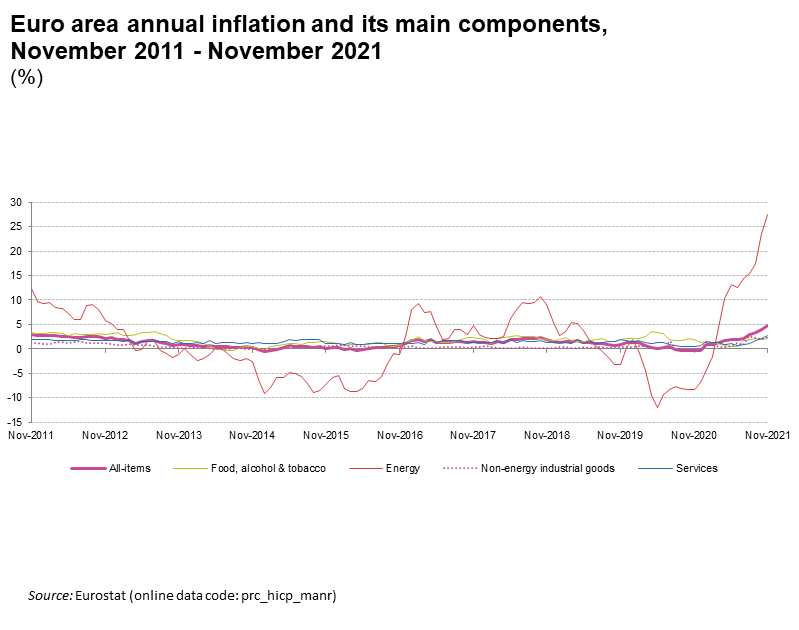
Inflation in the euro-zone - Source: ec.europa.eu
Central banks also control the supply of money available in the economy by literally printing new money. Sounds like a dream, right?
For illustration, the US Federal Reserve printed somewhere between $340B and $430B in 2021.
Interested in more details about the economic machine and the role of central banks? Check this great video from Ray Dalio.
Dealing with inflation in your personal finance
Inflation is sneaky. You’d think you’re protected from it if your investments have a > 0% annualized return. Indeed, every year, you see your investments account grow, but that doesn’t take inflation into account. Amount of money != purchasing power.
So you could be losing purchasing power if your investments have a return lower than inflation. You have more money in your investments account but you can buy fewer goods & services with it!
To maintain the same purchasing power, your investments should match inflation. And that requires more work than simply putting money into a savings account, as they usually have low returns compared to inflation.
The reasons for the current inflation are complex and it doesn’t affect all spheres of the economy equally. Some assets are less impacted by inflation. Two examples:
- Shares of companies which have a strong pricing power tend to do well in times of inflation (meaning they can increase their price and keep a similar volume of sales)
- Assets whose supply cannot be easily increased also tend to resist inflation (gold is hard to mine, bitcoin’s supply is limited to 21 million)
Wrapping up & action items
Just like taxes on capital gain, inflation is real. The earlier you realize this and factor it into your investment strategy, the better you’ll be. That’s perfect since investment strategy is the topic of our third episode of Jeune Investisseur 😉 - you can listen to it here 🎧.
- Having all your net worth in cash means your subject to inflation and could end up in the case of the Yapese of our intro story;
- All assets don’t react the same to inflation, some are a better hedge against it than others.
- Diversify to hold values that resist inflation in your portfolio (think about the assets that are hard to duplicate)
Bibliography
A non-exhaustive list of resources that helped us craft the content for this episode.
- Investopedia, Inflation, investopedia.com, accessed Dec. 22, 2021.
- Plan Épargne Logement (PEL), service-public.fr, accessed Sep. 27, 2021.
- La finance pour tous, lafinancepourtous.com, accessed Sep. 28, 2021.
- The Island of Stone Money, NPR, accessed Sep. 29, 2021.
- Consumer Price Index (CPI), investopedia.com, Accessed Oct. 8, 2021.
- US Consumer Price Index (CPI) evolution - official inflation figures, data.bls.gov, accessed Dec. 22, 2021.
- US Dollar market in Afghanistan, NPR Planet Money, NPR.org, accessed Dec. 22, 2021.
- Why does the Federal Reserve aim for inflation of 2 percent over the long run?, The FED, accessed Sep. 1, 2021.
- Our monetary policy statement at a glance, Banque Centrale Européenne, accessed Sep. 27, 2021.
- Livret A: Comment ça marche ?, economie-gouv.fr, accessed Sep. 30, 2021
Investopedia is a great resource whenever you seek a definition of seemingly complex financial or economic concepts. They even have short videos making it easy to grasp a concept in 2 to 3 minutes.
Cover photo by Krzysztof Hepner on Unsplash